LBST

Why is it important?

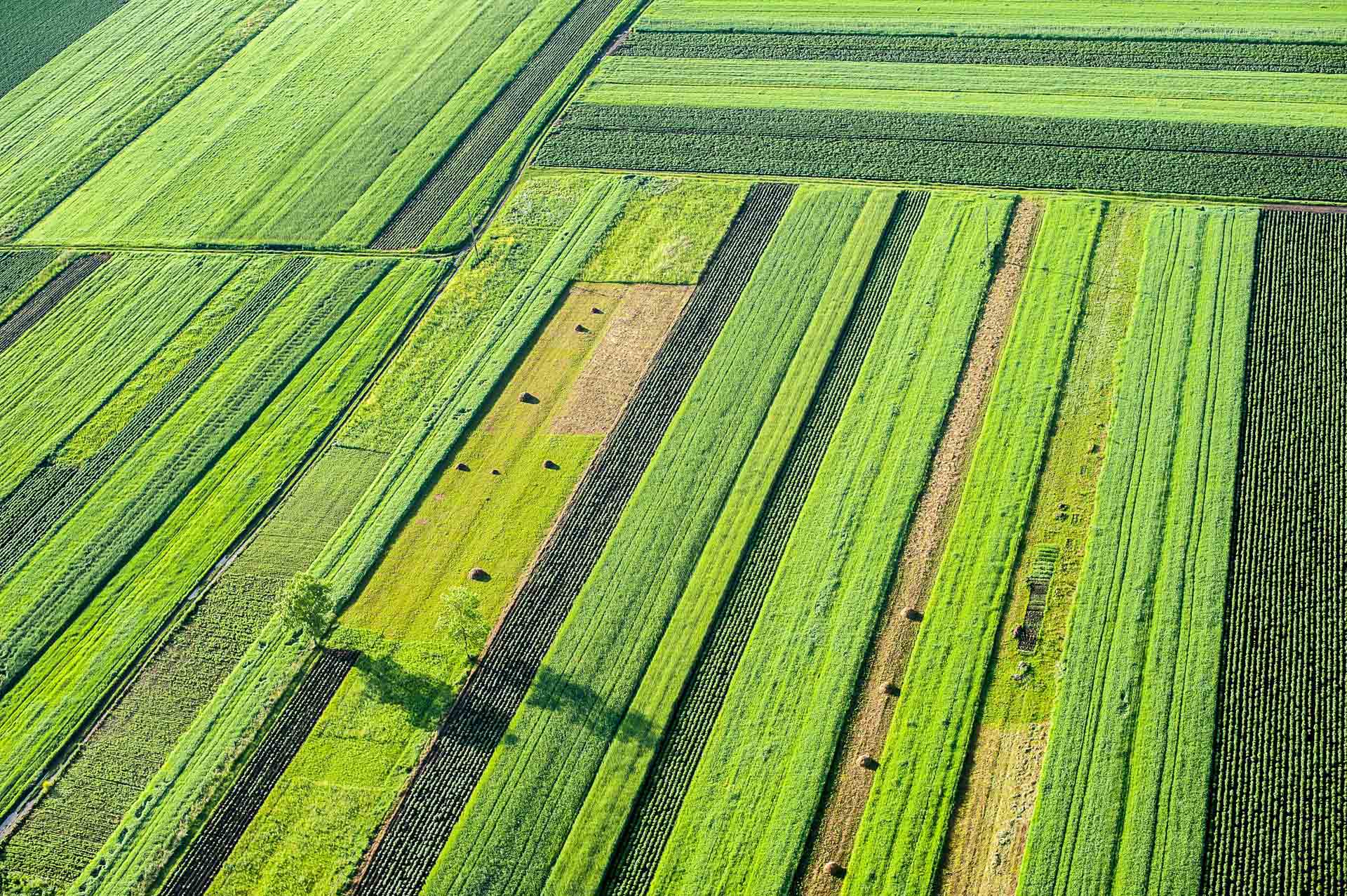
EU agricultural subsidy schemes involve substantial public funding and require transparent, consistent, and reliable monitoring of farming activities. Traditional field based inspections are costly, time consuming, and difficult to scale when monitoring hundreds of thousands of agricultural parcels nationwide. Satellite based monitoring enables a fundamental shift in how agricultural controls are conducted. By providing objective, harmonised, and frequently updated information on land use, land cover, and agricultural practices, authorities can improve efficiency, reduce administrative burden, and ensure fair and timely subsidy payments in line with EU CAP requirements.

Project highlights:

Continuous, wall‑to‑wall monitoring of all agricultural fields in Denmark using satellite imagery, enabling near‑real‑time observation of land use, land cover, and farming activities at national scale.

Advanced machine‑learning and image‑processing workflows translate Earth observation data into actionable indicators for EU Common Agricultural Policy (CAP) compliance, replacing manual inspections with objective, data‑driven evidence.

Direct integration of satellite‑derived insights into the Danish Agricultural Agency’s operational systems, supporting transparent and efficient administration of EU agricultural subsidies exceeding EUR 800 million annually.

In more detail..

Since 2016, DHI has worked in close collaboration with the Danish Agricultural Agency (DAA) to develop and operationalise a frontrunning satellite based monitoring solution for the EU Common Agricultural Policy.

This long term partnership has proven to be a recipe for success, positioning Denmark as a trendsetter in public digitalisation and enabling full national scale operational use since 2019.

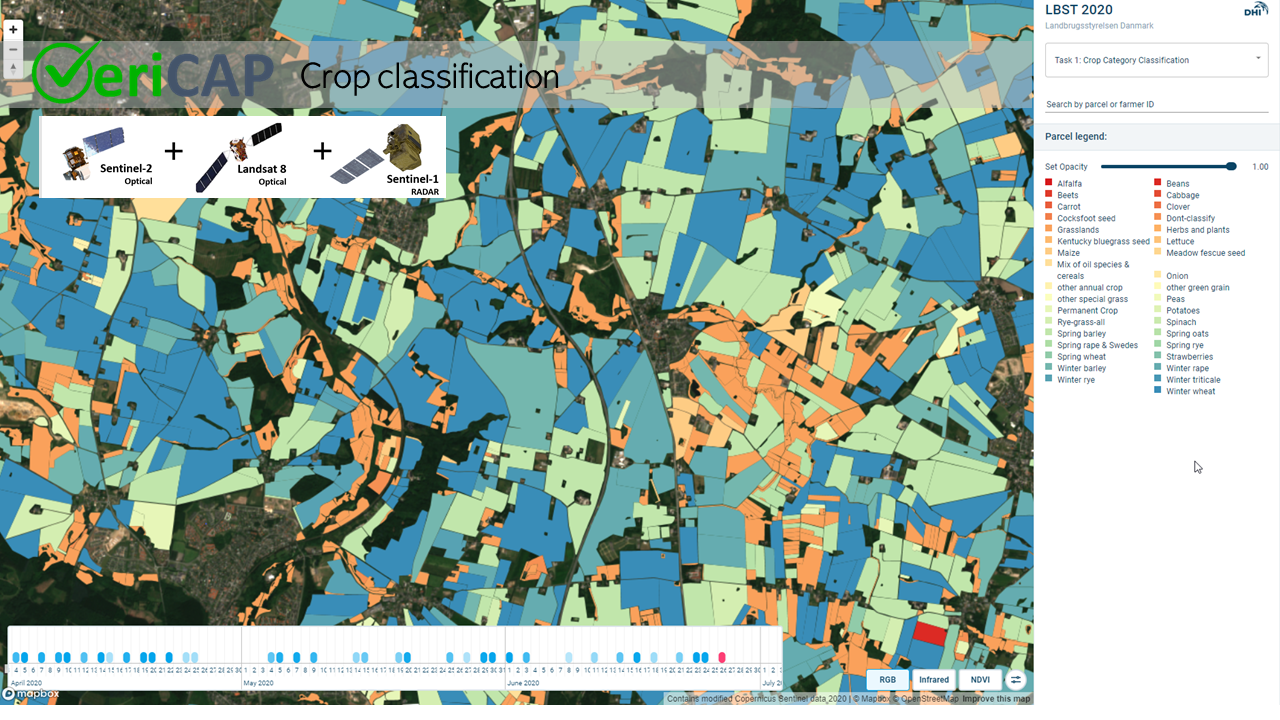
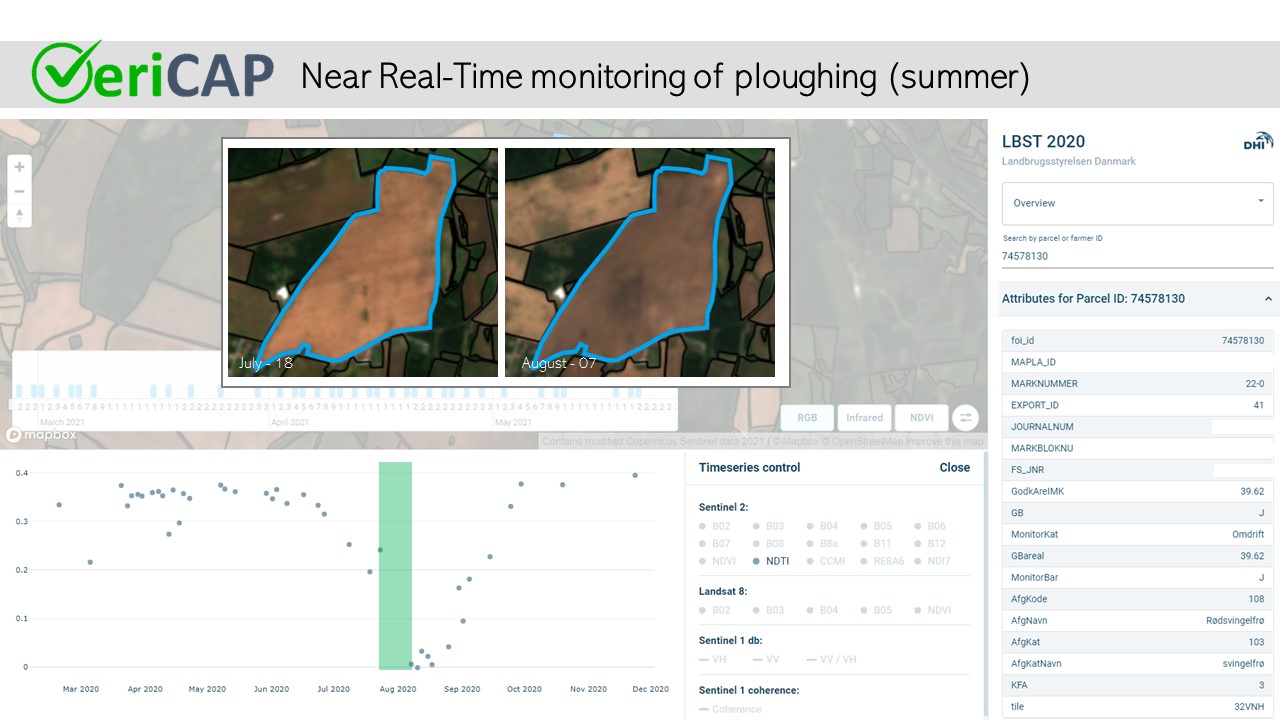
The CAP monitoring solution builds on DHI’s long standing expertise in satellite based agricultural monitoring. The technical backbone of the system is VeriCAP, which provides a streamlined, flexible, and accurate Check by Monitoring (CbM) and Area Monitoring System (AMS) solution. VeriCAP enables continuous monitoring of crop types and farm management practices in accordance with EU CAP rules and requirements, using Earth observation data combined with advanced image analysis techniques.

In 2019, the solution was successfully piloted at national scale in Denmark, demonstrating its capacity to monitor approximately 600,000 agricultural fields at 10 metre spatial resolution. Since 2020, the system has been fully operational as a running service, with satellite‑based information automatically integrated into the Danish Agricultural Agency’s IT systems and operational workflows. Today, it supports the administration of agricultural subsidy payments exceeding EUR 800 million annually. Denmark is widely regarded as a frontrunner in large‑scale implementation of satellite‑based CAP monitoring.

Together with the Danish Agricultural Agency, we have been among the first to establish a fully operational national‑scale system. At the same time, the Danish experience highlights that effective CAP monitoring solutions must be tailored to each country’s specific administrative practices, regulatory interpretations, and implementation models within the EU framework..

The approach has enabled the Agricultural Agency to harmonise existing monitoring frameworks, significantly reduce the need for physical field visits, increase effectiveness, and lower administrative costs. In recognition of its impact and its ability to exploit the potential of digitalisation to improve public administration, the solution received the Innovation Award at the Danish Digitalisation Awards in September 2021.
The Danish Agricultural Agency:

The project is delivered by DHI under a multi year contract with the Danish Agricultural Agency, supporting national implementation of the EU Common Agricultural Policy through satellite based monitoring and digitalised control workflows.

Related items

Earth Observation Centre of Excellence part of the DHI GROUP

info@dhigroup.com
+45 4516 9200

Agern Alle 5,
2970 Hørsholm,
Denmark

CVR: 36466871

EO4Hazards

Why is it important?

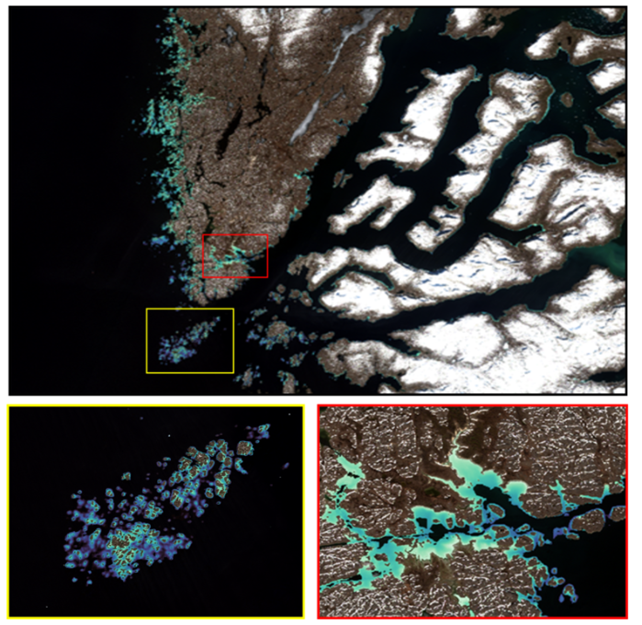
Navigating Greenland’s coastal waters is increasingly challenging as climate change reduces sea ice cover and expands maritime activity into remote and poorly charted areas. Large sections of the Greenlandic coastline remain insufficiently surveyed, particularly in shallow near shore zones where the risk of vessel grounding is highest. In addition, tidal measurements are sparse, making it difficult to anticipate local tidal conditions in fjords and unmonitored areas. Recent grounding incidents involving supply vessels and cruise ships illustrate how gaps in bathymetric and tidal information can directly compromise safety at sea and emergency preparedness. EO4Hazards addresses these risks by providing scalable, satellite derived coastal hazard intelligence that complements traditional surveys and supports safer navigation, planning, and response in Arctic waters.

Project highlights:

Analysing and documenting the information needs and operational constraints of maritime authorities and vessel operators in Greenland, with a focus on navigation safety in shallow, poorly charted coastal waters

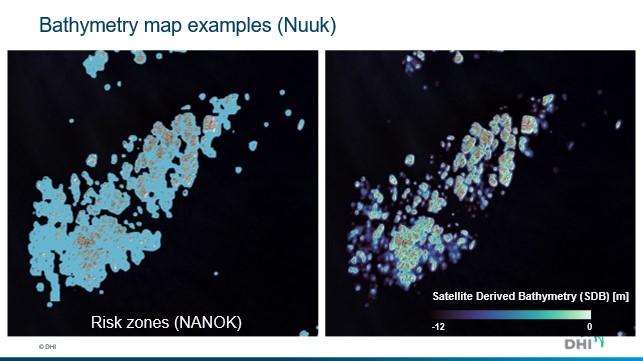
Assessing and developing Earth observation methods to detect submerged navigational hazards, estimate shallow‑water bathymetry, and reconstruct spatially varying tidal conditions using satellite data and machine learning.

Demonstrating how EO‑derived coastal hazard intelligence can support safer maritime operations, improved situational awareness, and better preparedness for navigation and emergency response in Arctic waters.

In more detail..

EO4Hazards builds on the DHI led NANOK project by extending satellite based coastal mapping towards a more comprehensive coastal hazard intelligence framework.

The project integrates multiple Earth observation data sources, including Sentinel 2 optical imagery, ICESat 2 altimetry, and sea surface height measurements from the SWOT mission, combined with machine learning models tailored to Arctic coastal environments.

A central innovation of EO4Hazards is the reconstruction of spatially varying tidal conditions using SWOT data, closing a long standing information gap in narrow fjords and near shore waters where conventional satellite altimetry and tide gauges are unavailable. These tidal estimates are used to correct and contextualise shallow water bathymetry products, enabling more robust identification of hazardous zones relevant for navigation.

The project focuses on selected areas along Greenland’s west coast, including fjords and coastal approaches where traditional hydrographic surveys are sparse or non existent. All workflows are designed for scalability, enabling rapid large area mapping that would be impractical using vessel based surveys alone.

EO4Hazards places strong emphasis on operational relevance. The generated products are tested and evaluated in collaboration with maritime authorities and operators, ensuring that outputs are fit for real world use and can be delivered in formats compatible with existing navigation and planning systems.

The National Defence Technology Centre:

This project is financed by The National Defence Technology Centre (NFC). NFC supports defence technology research and testing in Denmark at the highest international level.

It is led by DHI in collaboration with DTU Space and the Greenland Institute of Natural Resources.

Related items

Earth Observation Centre of Excellence part of the DHI GROUP

info@dhigroup.com
+45 4516 9200

Agern Alle 5,
2970 Hørsholm,
Denmark

CVR: 36466871

Global Wetland Watch platform launched: a new open window on the world’s wetlands​

Global Wetland Watch platform launched: a new open window on the world’s wetlands

28 April 2026

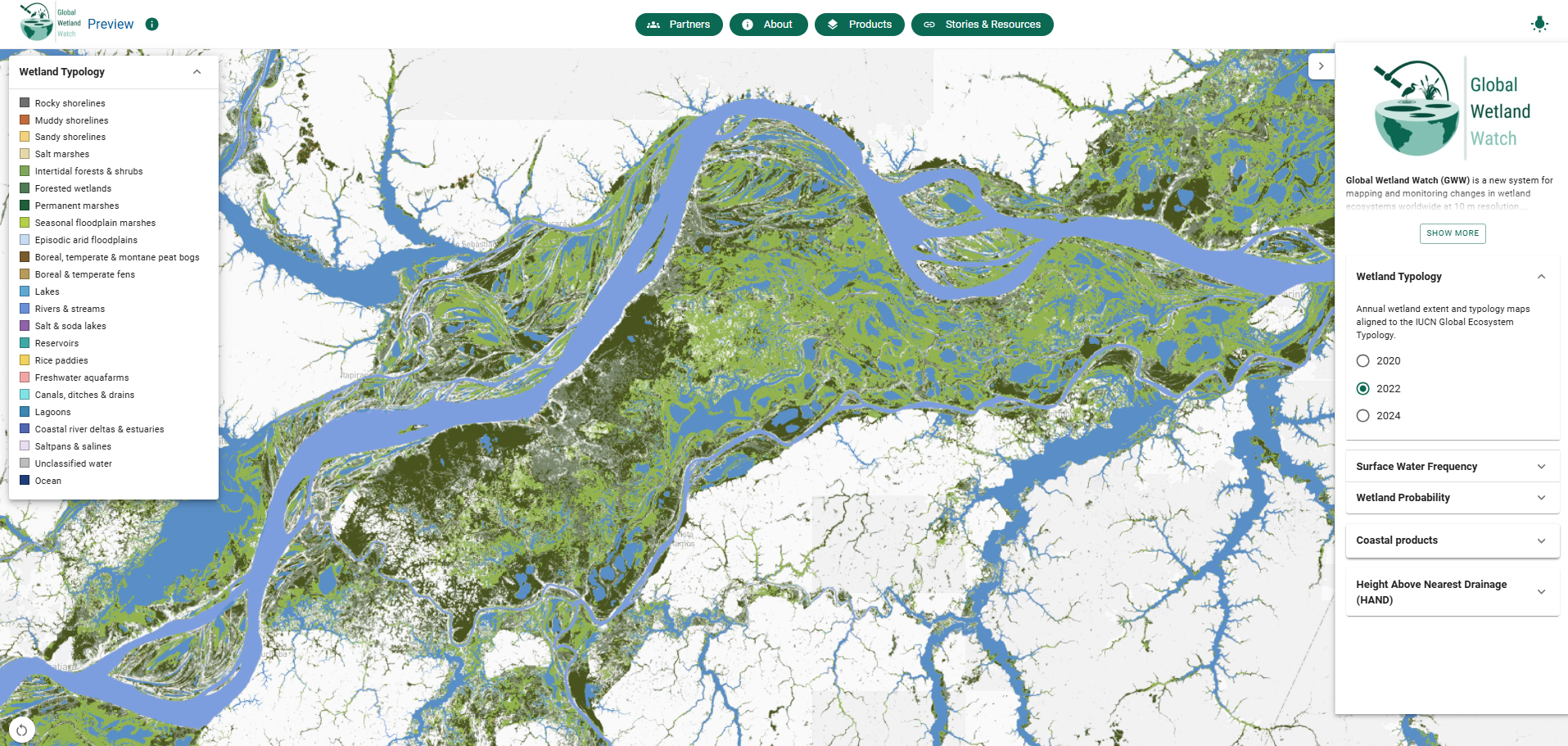
DHI and partners have officially launched the preview version of the Global Wetland Watch (GWW) platform, making decades of advances in Earth observation available through a single, open and globally consistent platform.

The preview launch coincides with World Wetlands Day 2026 and provides early access ahead of the full platform release scheduled for December 2026.

Explore the Global Wetland Watch map

Wetlands are among the most important ecosystems on the planet. They regulate water flows, capture and store carbon, buffer communities against floods and droughts, support biodiversity, and sustain livelihoods and cultural heritage worldwide. Despite their importance, wetlands continue to decline globally, often due to inconsistent monitoring approaches and limited access to reliable data.

A global, data‑driven view of wetland change

Funded by Google.org and powered by Google Earth Engine, Global Wetland Watch combines satellite imagery, artificial intelligence, and hydrological expertise to provide a consistent global picture of wetlands and how they change over time.

The platform is developed through a collaboration between DHI, the UNEP–DHI Partnership – Centre on Water and Environment, and the United Nations Environment Programme (UNEP).

From experts to communities

By making advanced Earth observation analytics openly accessible, Global Wetland Watch lowers the barrier to engaging with wetland data. Governments, NGOs, researchers, Indigenous Peoples, and local communities can explore wetland extent and dynamics without the need for specialist software or advanced technical expertise.

Preview now, full launch later this year

The current release represents a public preview of the Global Wetland Watch platform. Additional datasets and capabilities will be introduced ahead of the full platform launch in December 2026.